Here are the 8 best keyword research tools I recommend for startups to begin a well-rounded keyword foundation for SEO.

My methodology, therefore, was simple:
I would test 8 big keyword research tools for all of these criteria, then assign a grade between 1–5 for each. This would result in an overall score out of twenty-five for each tool.
SIDENOTE.
For the “keyword suggestions” criteria, I used the same keyword—”massage”—in each keyword tool to make sure that the results were comparable.
Here are the detailed results:
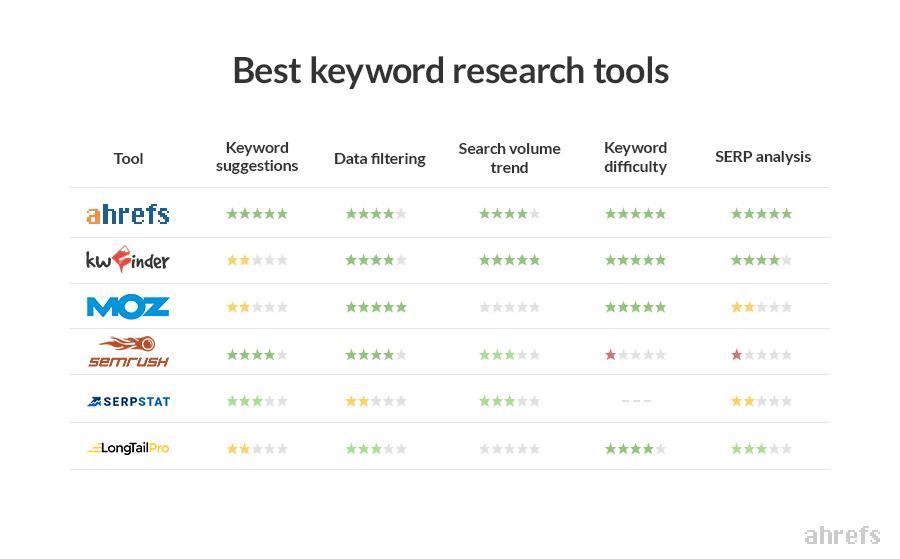 Let’s take a look at a more detailed breakdown of each tool.
Read also Related Post : 11 Best SEO Tips
Let’s take a look at a more detailed breakdown of each tool.
Read also Related Post : 11 Best SEO Tips

SIDENOTE.
For the “keyword suggestions” criteria, I used the same keyword—”massage”—in each keyword tool to make sure that the results were comparable.
Are you struggling to uncover new keywords in your keyword research?
This is a challenge that you may face when launching your new site. While you’re familiar with the top keywords in your niche, you don’t know where to go from there. And, as you know, that can be a problem as you create more content.
Consider this keyword tool a great way to help.
With the AdWord & SEO Keyword Permutation Generator tool, it’s easy to get creative as you search for keywords that align with your site, marketing strategy and goals.
The thing that I like best about this tool is the way that you can get creative. You can enter a keyword in each of three boxes, hit “generate permutations” and watch the magic happen.
Here’s an example:

As you can see, the more keywords you add into the first three boxes, the more results you’ll receive.
The only downside to this tool is that some of the keyword results may not make sense. For this reason, you must be prepared to spend a good amount of time moving through the list, searching for those that best suit your site.
If keyword creativity is an issue for you, let this tool be your guide. It’ll point you towards some ideas that you may not have previously considered.
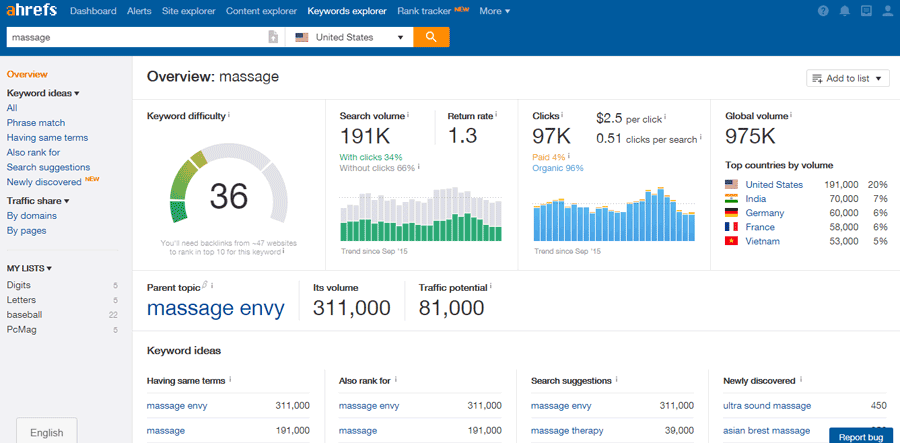
Number of keyword suggestions*: 5/5
Suggested: 892,576 keywords
Ahrefs pulled the maximum number of keyword suggestions and left all other tools far behind. Ahrefs’ Keyword Generator is powered by clickstream data and updates its database with fresh keywords every month.
Ahrefs allows you to filter the whole list of keyword suggestions by search volume and keyword difficulty. These two metrics are cached and always available for the entire database of keywords.
This tool has also got some unique keyword metrics (and thus filters) for the list of keyword suggestions not found in other tools such as:
But they will only be pulled after you click “Get metrics” button.
Search volume trend*: 4/5
Not only this tool shows the search volume trend starting from September 2015, but it also breaks it down further based on whether the searches result in actual clicks.
Search volume trend graphs is a visualization and does not show the search volume numbers for the past months.
Read also Related Post : 11 Best SEO Tips
Keyword difficulty calculation in Ahrefs Keywords Explorer is entirely based on the backlink profiles of the top10 pages in SERP and nothing else. Yet we’ve found that Ahrefs offers the most reliable metric over any other tool.
SERP analysis*: 5/5
A very detailed SERP analysis. Ahrefs will show you the accurate backlinks numbers for the search results. You can also see the SERP features (if any). And it’s the only tool that shows how much search traffic the top ranking pages are getting (from all the keywords they rank for, not just from your target keyword).
3. KWFinder (20/25 points)
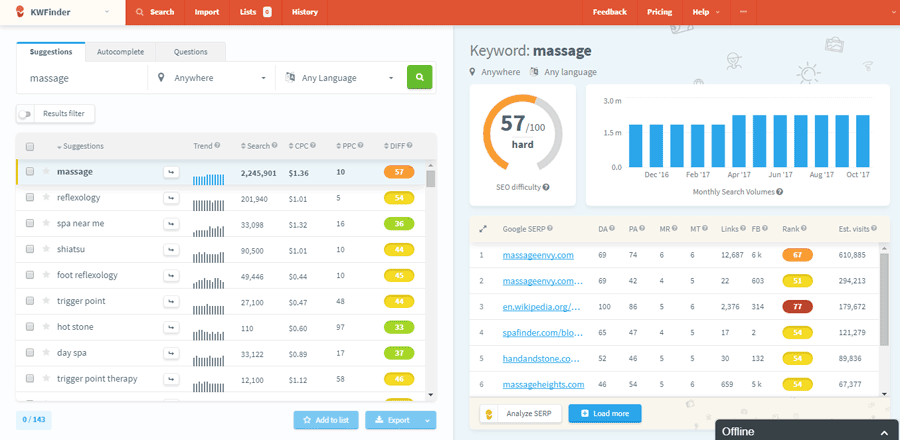
Number of keyword suggestions*: 2/5
Suggested: 954 keywords
The tool has three types of keyword ideas: suggestions, autocomplete, and questions, so I summed them up (after filtering out the duplicates).
SIDENOTE.
KWFinder caps keyword suggestions at 200 or 700, depending on your plan.Data filtering*: 4/5
Filtering with KWFinder is a breeze. There’s just one drawback: keyword difficulty data isn’t instantly available for every keyword unless it’s been requested by any user previously (unlike Keywords Explorer from Ahrefs which shows keyword difficulty for all the keyword suggestions).
Search volume trend*: 5/5
The search volume trend is nicely laid out in organic KWFinder style with all the data you’d expect.
Keyword difficulty*: 5/5
They calculate it based on SEO stats (DA, PA, MR, MT pulled from MOZ) of the pages on the first page of Google.
In my work, I found KWFinder’s SEO difficulty metric to be surprisingly accurate. Plus, it is easy on the eyes.
SERP analysis*: 4/5
KWFinder’s SERP analysis is super simple and easy to digest. However, they’re using backlink data from MOZ, which is not a perfect source. Maybe they should think about switching to Majestic API.
4. Google Correlate
As noted above, there’s nothing better than getting advice straight from the source. And, once again, Google is the source I’m talking about.
Google Correlate is an often overlooked tool that can be extremely powerful for generating a large keyword list.
The primary reason to use this tool is the ability to see which keywords get searched together. With this information, you can begin to grow your keyword list (especially longtails).
In the example below, you’ll see that people who search for “diet plan” also search related phrases:

So, while diet plan may be your primary keyword, there are several others that you can focus on, as you create your content calendar. For example, you may decide to create a blog post based on some or all of the “correlations.”
If you find yourself in a keyword rut, Google Correlate can help you escape. You simply enter your primary keyword. From there, the tool does all of the work for you.
5. IMforSMB Bulk Keyword Generator
Some keyword tools are good for every type of website. Others, however, are only a good fit for a particular site type.
This is where the IMforSMB Bulk Keyword Generator fits in. This tool works best for local service companies, as it’s designed with the idea that you’ll want to find local keywords.
Using the tool begins with selecting a category:

From there, take the time to carefully choose your service type:

Finally, enter your service location and click “Generate Keywords.” Then, get ready to be mesmerized by the results.

These results aren’t anything special, as you could eventually come up with the same keyword list by using another tool. However, with its local approach, you’ll feel as if you’re on the right track quicker.
Pro tip: even if your business type isn’t available, you can still use this tool. You’ll have to replace some of the keywords with your own, in the search results. But, you’ll end up with the same basic results.
6. Soovle
Have you ever used Google’s autocomplete feature to generate keywords or a blog post title?
If this is a trick you’ve used in the past, you’ll love what Soovle has to offer.
In short, this free keyword research tool provides autocomplete suggestions from a variety of sources, not just from Google, to help you boost your search volume.
While you can use it for Google suggestions, there are many other sources, including Yahoo, Bing, YouTube, Wikipedia and Amazon.
The first thing you need to do is choose your source. Google is the default, but you can change this easily enough, by clicking on one of the many other icons below the search box.

The search results aren’t the most advanced, but you’ll probably find a few suggestions that make sense for your blog. For example, a search for “content marketing” shows the following suggestions from Google:

As you jump around to other sources, such as Yahoo, the results change:

The best way to use Soovle is to experiment with a variety of keywords, while paying close attention to the results from each source.
Using Soovle is as simple as entering your keyword and reviewing the results. It’s quick, it’s efficient and it’ll guide you towards a few good keywords.
7. Ubersuggest
Do you rely heavily on the Google Keyword Planner?
If so, you expect this tool to provide you with all of the keywords and data that you need to make informed decisions. And, while this typically holds true, it’s important to remember one thing: you may not be getting as much data as you think.
Ubersuggest provides you with keywords that are not available through the Google Keyword Planner.
With this in mind, I suggest that you always run a Ubersuggest search, after checking your keywords through the Google Keyword Planner.
Type in your keyword to this keyword tool and click “suggest.” This generates a list of keywords that is big enough to keep you busy for quite some time.
The thing that I like best about Ubersuggest is the way that it breaks down results by the letter. For example, a search for “content marketing” and the letter “a” shows the following:

With this organized approach, you have a better chance of reviewing every keyword, without missing one that could be a game changer for your site.
Pro tip: in addition to a web search, you can also search Images, Shopping, YouTube and News.
8. Long Tail Pro (12/25 points)
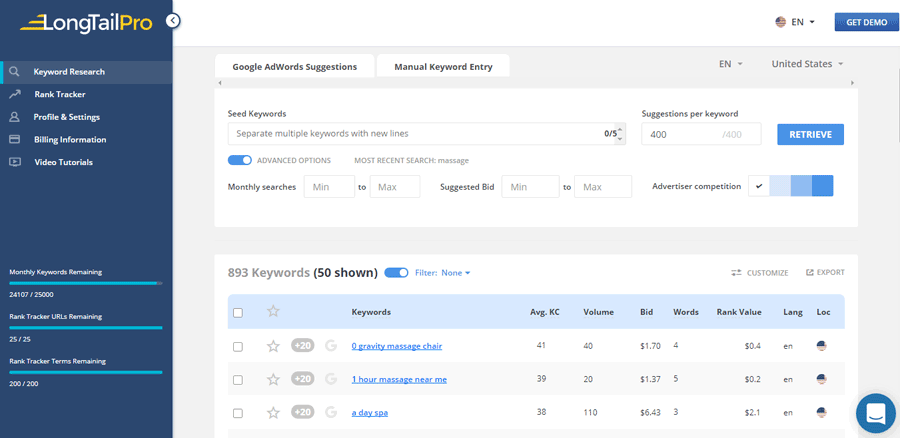
Number of keyword suggestions*: 2/5
Suggested: 893 keywords
A reasonable number of suggestions, but due to limitations in “Max results per seed keyword” I had to run their “Google AdWords Suggestions” report multiple times.
Data filtering*: 3/5
Quite a few filtering opportunities, but the interface could probably use some improvement. As for me, it is a bit slow and clunky.
Search volume trend*: 0/5
Does not provide ‘search volume trend’ data.
Keyword difficulty*: 4/5
Keyword Competitiveness in this tool is calculated using the page title, Majestic Trust Flow and Citation Flow, links, and other factors of top 10 results found on Google.
Keyword difficulty score from Long Tail Pro was the second most accurate one after Ahrefs in our keyword difficulty test.
SERP analysis*: 3/5
Plenty of solid data. The downside of their SERP analysis is that it forces you into a new browser tab.
6. SERPStat Keyword Research Tool (10/25 points)
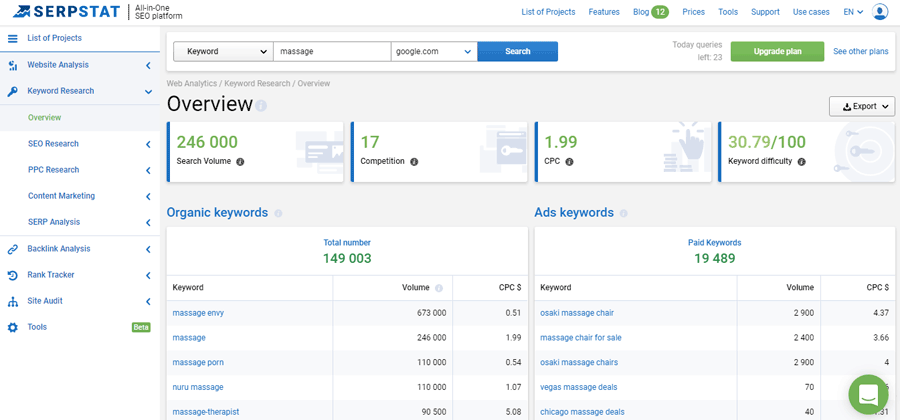
Number of keyword suggestions*: 3/5
Suggested: 149,003 keywords
Serpstat offered a good number of keyword suggestions. Around 35% of what SEMrush shows.
Data filtering*: 2/5
Provides some good filtering options. But you can’t filter or sort a list of suggestions by keyword difficulty.
Search volume trend*: 3/5
Leverages the power of an embed from Google Trends. Yet, it does give you an overall picture of the search term’s popularity over time.
Keyword difficulty*: ?/5
Serpstat estimates their keyword difficulty based on a number of various factors, such as backlink profiles of the top10 search results, their Page Rank and Trust Rank, and on-page factors such as keywords in title and URL.
This metric was added to Serpstat in June 2017 and I did not test it hard. So, unfortunately, I can’t give you my conclusion here.
A few words about the criteria used above
I suppose I have to add a few words about the criteria I used to grate these amazing tools: why I used exactly these and what I expected from every tool.
Number of keyword suggestions
Generally, the more keywords you have to work with, the more likely you are to find the gems.
The only fair way to compare keyword tools based on suggestions number is to run the same query through each and record the results.
I used the keyword “massage”. (That was actually one of the first words that came to mind. I could really use a massage right about now…)
The keyword suggestions count was pulled on 17 Nov 2017. And since these keyword tools regularly update their databases, you will probably get a slightly different number if you run a similar test today.
Data filtering
A huge list of keyword suggestions is only a starting point for a keyword research. Further on you need to filter this list effectively, otherwise, you’re just biting off more than you can chew.
A good keyword tool must provide easy filtering options. And no matter what other keyword metrics these tools have, search volume and keyword difficulty are a must.
Search volume trend
Now that you have some keyword gems after filtering down a list of keyword suggestions, you need to do individual keyword analysis.
It is essential to have the keyword search volume trend over time to see if the searcher’s interest is rising or fading and if seasonality influences it.
Keyword difficulty
This section requires some extra talk.
Today every good keyword research tool has some form of difficulty or competitiveness score (do not confuse it with ‘Competition’ in GKP which only applies to ads).
This metric must show you how hard it would be to rank for any given keyword. With it, you can easily filter a huge list of keyword suggestions and find those easy to rank for.
Most SEOs estimate keyword difficulty based on the backlink data of the pages in top search results. But different tools may have their own approaches.
The rates above are based on my own experience in keyword research and further ranking for many keywords. Besides, it incorporates data from our Keyword Difficulty Test.
That’s why Ahrefs gets 5/5, not just because it’s my personal favorite SEO tool.
If you still think I’m just biased towards Ahrefs, here’s another keyword difficulty study carried out by Kelvin Mah from Humanproofdesigns recently:
Ahrefs wins there as well.
SERP analysis
This one has a lot of weight for me.
Keyword difficulty can help you narrow down your huge lists of keyword suggestions. But it won’t replace the manual review of the SERP. This is why a good keyword tool should not only give you a fairly reliable keyword difficulty score but also give you enough data to dig in once you have identified potential gems.
Why I didn’t include Google Keyword Planner (and a few other keyword research tools)
You probably noticed that Google Keyword Planner wasn’t included in my test.
This is because GKP is a specialized tool for PPC advertisers and is not really supposed to help with organic keyword research. Already back in 2012 Rand Fishkin warned us to be careful using AdWords for keyword research.
Then one day Keyword Planner started to combine search volumes for similar keywords and phrases. That move was quite reasonable for PPC keyword research, considering the Ad will be shown for any keyword in such group. But without individual search volumes, GKP became a lot less useful for organic keyword research.
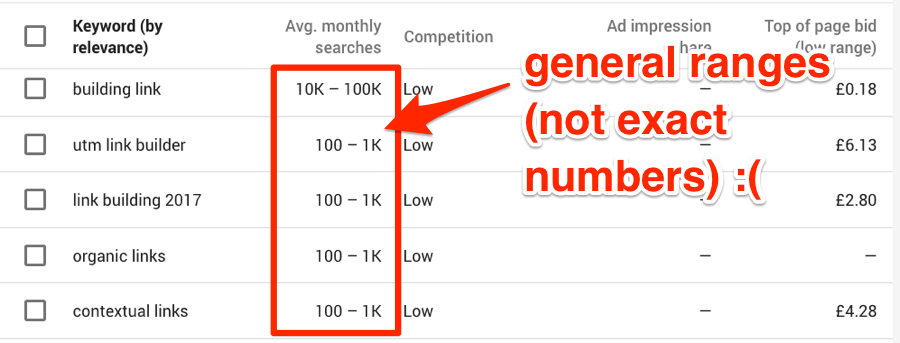
But still, Google Keyword Planner can be useful and it does have a few things going for it, namely:
So even with the annoying search volume limitations and the fact that you can only see 700 suggestions per keyword, there is still value to be had from GKP.
(You can learn more about how to use the Google Keyword Planner in this guide from Google themselves!)
But GKP aside, you may be wondering why I didn’t include some of the other well-known keyword research tools that scrape Google autocomplete and “related searches,” such as:
In all honesty, I did not test such tools because the number of suggestions they give is insufficient and because they usually don’t provide any “statistics” about the keywords they spit out. They might be fun to work with and helpful in some cases, but I don’t think they fall into “professional tools” category.
Final thoughts
You saw the results of my test. However, there are more things to consider when picking a keyword research tool. All in all, your choice must depend on the level of your SEO knowledge and the job you’re looking to accomplish.
Ahrefs is a tool for experienced SEOs who will make use of every detail they can get, while KWfinder is a perfect choice for someone who’s just starting out, considering its money/value ratio.
I’m a long-time user of Ahrefs, so it may seem that I’m biased. But, in all honesty, I love my business and my bank account more than any SEO brand. So if some other tool will help me better than Ahrefs, I’ll switch immediately.


